Motivation
Motivation is a result, not a cause
Stop waiting to feel like it
Manish Kumar Singh7 min read
In the early 1990s, the psychologist Neil Jacobson and his colleagues ran an experiment designed to take cognitive therapy for depression apart. They randomly assigned 150 outpatients with major depression to one of three treatments. One was the full package, with its work on distorted thoughts and deep-seated beliefs. One dropped the work on deep beliefs. The third kept only the most basic ingredient: helping people schedule activities and do them again, whether or not they felt like it.
All the treatments were delivered by experienced cognitive therapists, and the authors acknowledged a clear bias in favour of the full therapy. It made no difference. The stripped-down version, called behavioural activation, did as well as the complete treatment at the end of therapy and at six months. A two-year follow-up of 137 of the patients found the full therapy was no better at preventing relapse. Negative thinking even improved just as much under the activity-only version, which is strange if you believe thoughts have to change before behaviour can.
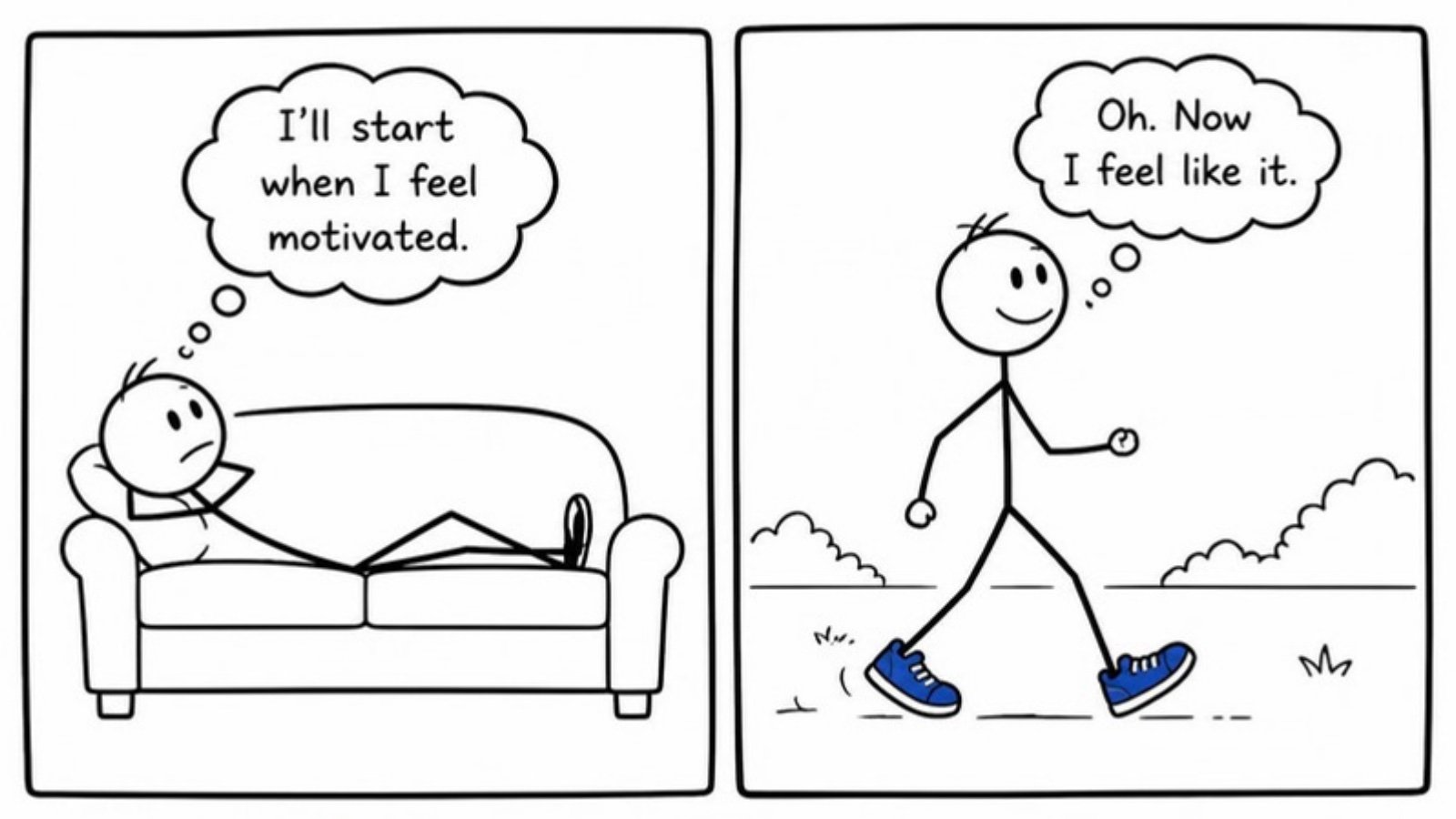
Most of us treat motivation as the fuel for action: first the feeling, then the work. The evidence from clinics, offices and a university café points the other way. Motivation is mostly something action produces. Waiting to feel like it means waiting for an output before supplying the input.
The therapy that schedules action before mood
Behavioural activation rests on a blunt idea. In their clinician's guide to the method, Christopher Martell, Sona Dimidjian and Ruth Herman-Dunn state the first principle as "the key to changing how people feel is helping them change what they do." They call it acting from the outside in: you do the activity, and the feelings follow. Patients are asked to act according to a plan rather than a mood, with tasks broken into parts and written into a schedule at a specific time and place.
The bigger test came in 2006. Dimidjian and colleagues randomly assigned 241 adults with major depression to behavioural activation, cognitive therapy, antidepressant medication or a placebo pill. Among the more severely depressed patients, behavioural activation performed as well as medication, and both did significantly better than cognitive therapy. A treatment built on scheduling things to do held its own against drugs for the patients who were hardest to help.
The COBRA trial, published in The Lancet in 2016, randomised 440 adults in Devon, Durham and Leeds to behavioural activation delivered by junior mental health workers or to cognitive behavioural therapy from qualified psychological therapists. After a year, the two groups had the same average depression score: 8.4 on the standard PHQ-9 questionnaire. The simpler treatment, given by staff with far less training, was no worse.
A word of care. Clinical depression is an illness, and none of this suggests a low mood can be fixed with a to-do list or that anyone struggling should skip professional help. The point is narrower and more useful. The people with the least motivation of anyone, patients whose illness drains the wish to do anything, get better when treatment asks them to act first. If that order works for them, it is worth asking why the rest of us insist on the opposite order for a sales report.
Why the feeling arrives second
Behavioural activation explains depression partly in terms of reward. When life gets hard, people withdraw. They stop seeing friends, skip exercise, put off the difficult project. Each withdrawal removes a source of reward, mood drops, and further withdrawal becomes more likely. The guide describes these short-term coping habits as the behaviours that keep people stuck. Waiting to feel better is part of the trap, because the activity that would produce the better feeling has been taken off the calendar.
A useful way to see the everyday version is to treat motivation less like a fuel tank and more like a forecast: your sense of whether effort on something is going to pay off. That forecast is built from recent experience. If you have not touched a project for a week, you have no recent evidence that it is going anywhere, so the forecast stays gloomy and the feeling never shows up. The reliable way to change a forecast is new evidence, which means doing some of the work.
Teresa Amabile and Steven Kramer found the workplace version of this loop. They asked 238 people on 26 project teams in seven companies to fill in a short diary at the end of every workday, producing nearly 12,000 entries. The most common trigger of a good day was progress in the work, often a small step. Bad days were the mirror image: setbacks occurred on 67 per cent of people's worst-mood days, while progress appeared on only 25 per cent of them. Small events carried surprising weight. In 28 per cent of incidents that had only a minor impact on the project, people reported a major impact on how they felt about it.
Amabile and Kramer are careful here. Their data are correlations. Good moods could produce progress as easily as progress produces good moods, and they conclude the causality almost certainly runs both ways. That is exactly the point. It is a loop, and a loop can be entered at either end. You cannot order yourself into a good mood on a Tuesday morning. You can make a small piece of progress, which is the end of the loop you actually control.
Managers mostly miss this. When the researchers asked 669 managers to rank five ways of motivating staff, only 35 put support for progress first, about 5 per cent. Most ranked it dead last, behind recognition, incentives, interpersonal support and clear goals.
The closer you get, the harder you push
The third body of evidence explains why starting feels hardest. In 1932 the behaviourist Clark Hull proposed the goal-gradient hypothesis: the pull of a goal grows stronger the closer you get to it. In a later experiment, his rats ran progressively faster down a straight alley as they neared the food.
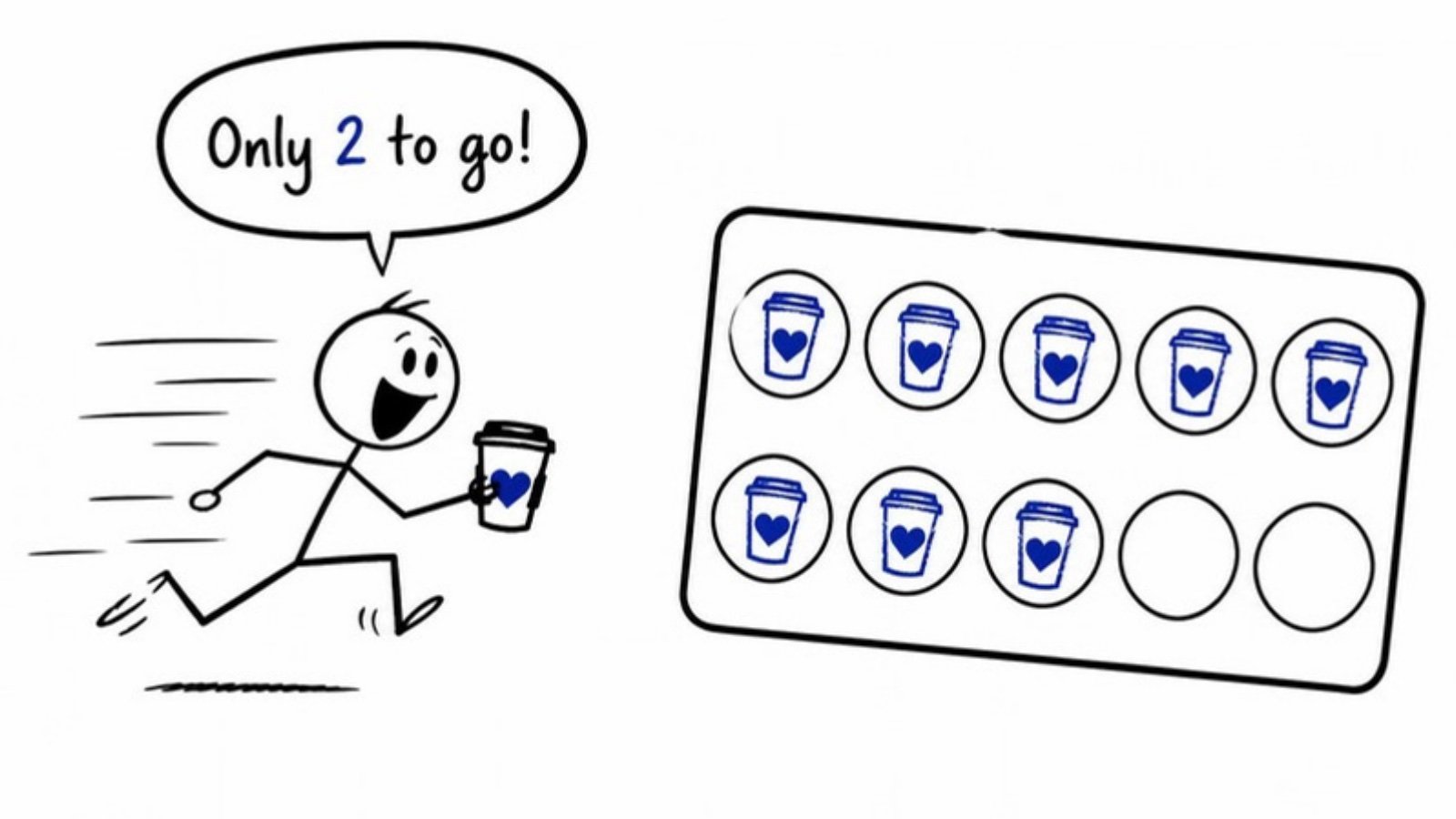
In 2006 Ran Kivetz, Oleg Urminsky and Yuhuang Zheng tested the idea on people, using a buy-ten-get-one-free card at a café on a university campus. As customers collected stamps, they came back sooner. The average gap between purchases shrank by about 20 per cent, or 0.7 days, from the first stamp to the last. After earning the free coffee, customers slowed down again, then sped up once more as they approached the next one.
Then came the clever part. The researchers randomly gave 108 customers one of two cards. One was a normal ten-stamp card. The other had twelve spaces, two of them already stamped as a bonus. Both required exactly ten purchases. The pre-stamped group finished in 12.7 days on average, against 15.6 days for the plain card: nearly three days, or about 20 per cent, faster. The reward was identical. Only the felt distance had changed.
In the authors' model, effort depends on the proportion of the distance still left to the goal, and at the very start all of it is left. Low drive at the beginning of a project is not a character flaw. It is what the goal gradient predicts. The same research predicts something else worth knowing: after you hit a milestone, motivation resets to a lower level before the next goal starts pulling.
Waiting to feel like it means waiting for an output before supplying the input.
Build the progress and the motivation follows
Put these findings together and the practical advice changes. Stop trying to feel motivated. Arrange to make progress, and make it visible.
Schedule by the clock, not the mood. Behavioural activation puts tasks at a set time and place so they no longer depend on how you feel when the moment arrives. Put the task you dread in your calendar as a meeting with yourself, with a start time and a location.
Make the first step almost embarrassingly small. The clinician's guide gives the example of someone who used to run for 45 minutes several days a week. The first assignment is not a run. It is buying running shoes before the next session, then running for ten minutes, and building from there. James Clear's popular two-minute rule, which says a new habit should take less than two minutes to start, is the self-help version of the same idea. The research explains why it works: a finished small step creates the evidence of progress that the feeling depends on.
Pre-stamp your own card. Break the work into steps and count what is genuinely done already: the research you gathered, the call you made, the outline you sketched. Writing those down as complete is not fooling yourself. It is an honest record, and it shortens the felt distance the way the bonus stamps did.
Log the wins. Amabile and Kramer found setbacks hit people two to three times harder than progress lifted them, so small wins need deliberate attention or they vanish. One line at the end of each day about what moved forward is enough. If you manage people, the same logic applies: remove the small obstacles that create setbacks, and make sure people can see the progress they are making.
Plan past the finish line. Because drive dips after a milestone, choose the first small step of the next piece of work before you close the current one.
The lesson
Motivation is mostly the feeling of progress arriving, so the way to get it is to make some progress first, however small.
Try this week: Pick the task you have avoided longest, book a fixed 15-minute slot for it in your calendar, list its first five tiny steps and tick off any already done, then write one line that evening about what moved.
A weekly letter on how people think, buy and work
One idea every Tuesday on psychology, marketing, sales, productivity and technology, with one thing to try that week.
Subscribe free