Marketing
Cheap clicks are the most expensive thing you'll buy
A low cost per click is a price tag, not a result
Manish Kumar Singh7 min read
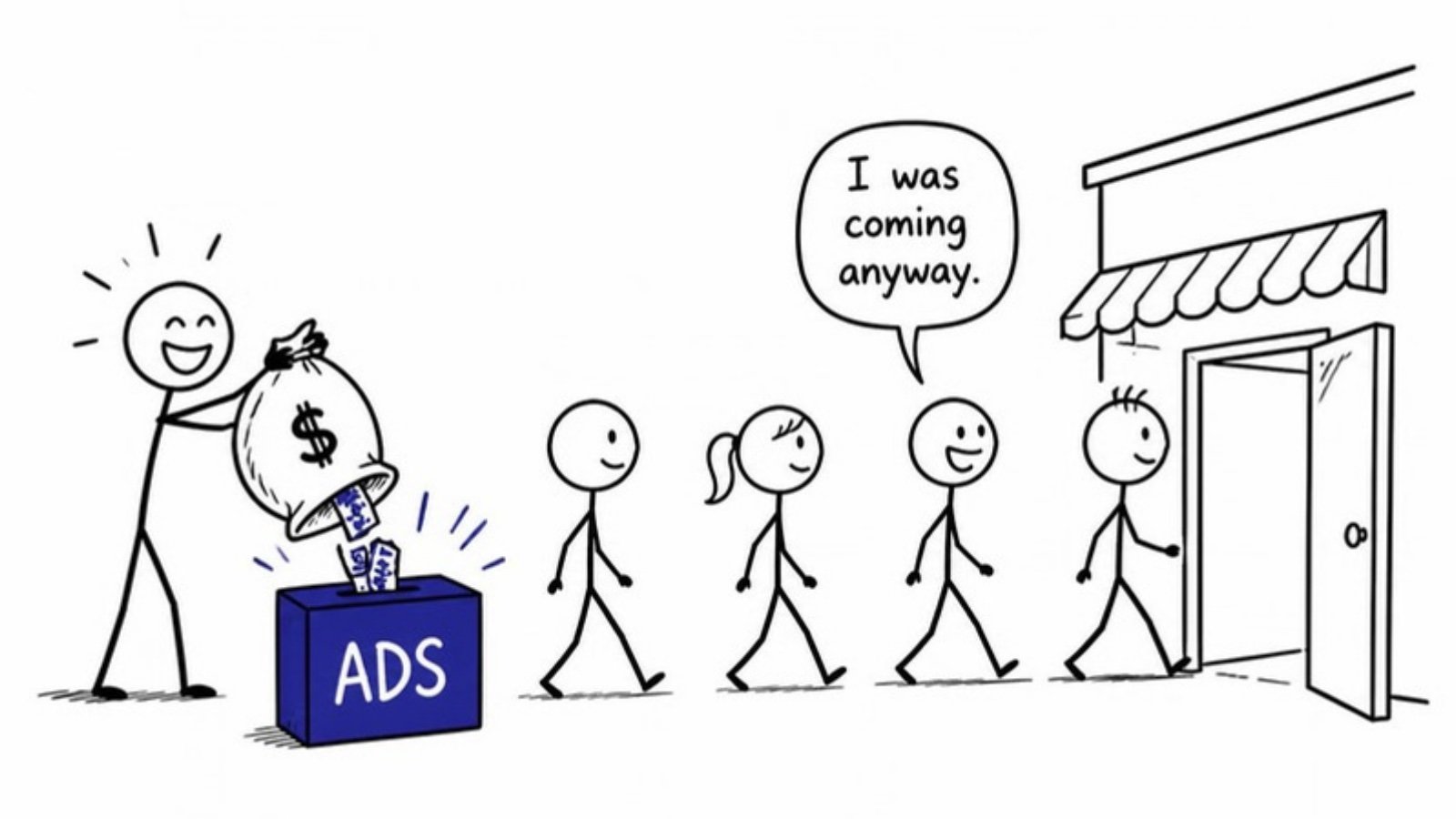
In 2012, eBay switched off the ads it bought on its own name. Anyone typing 'eBay' into Yahoo or Microsoft's Bing stopped seeing a paid link at the top of the results. The economists running the test, Tom Blake, Chris Nosko and Steven Tadelis, then counted how much traffic eBay lost. Almost none. Their paper, published in Econometrica in 2015, found that 99.5 percent of the clicks that used to come through the paid link now came through the free organic link sitting just below it.
Those brand clicks had been some of the cheapest, best-looking traffic in the account. People who search for eBay click and buy at high rates, so every report said the ads worked beautifully. They were cheap and they looked good for the same reason: the people clicking were already on their way. That is the argument of this essay. A low cost per click tells you something about the person on the other end, and it is rarely good news.
A price is information
Start with how the price is set. Search and social ads are sold by auction. On Google, as its own help pages explain, the winner of an ad slot pays only what is needed to beat the Ad Rank of the competitor just below. So the price of a click is set by other advertisers' willingness to pay for it. Advertisers who track their sales bid roughly what a click is worth to them, and that depends on how often that kind of click turns into money.
Read that way, a cheap click is a verdict. Plenty of companies with conversion data have looked at that searcher, that placement or that audience and declined to pay much. Sometimes they are wrong and you have found a bargain. More often the market has priced the click correctly and you are buying what everyone else passed over.
Then add the machine. Modern ad platforms don't just sell space; they choose who sees your ad. Meta's developer documentation is explicit that the optimisation goal you pick decides which people get your ad, and that the system aims to win auctions only when it expects to reach that goal. Pick app installs and it hunts for people likely to install. Pick clicks, and Google's Maximize clicks strategy sets your bids to get as many clicks as your budget allows. Neither system has been asked whether those people will ever buy.
And clicking is a strange, concentrated behaviour. When comScore and the agency Starcom studied US display advertising in 2009, they found that 8 percent of internet users produced 85 percent of all clicks, and that the heaviest clickers, just 4 percent of users, accounted for two thirds of them. Ask a machine for the cheapest clicks and it will go looking for those people. They are real and cheap to reach. They are not a sample of your customers.
Paying for customers you already had
The brand test was only eBay's warm-up. The bigger question was the rest of its search spending, spread across more than 100 million keywords such as 'used gibson les paul'. So the team stopped all non-brand search ads for 60 days in 68 US regions, roughly 30 percent of eBay's American traffic, and compared sales with matched regions where the ads kept running.
Paid search, it turned out, added about 0.66 percent to sales. The usual way of estimating returns, which relates spending to sales over time and across places, said the ads returned more than 4,000 percent. The experiment's best estimate was minus 63 percent. Same ads, same money. The dashboard asked who clicked before buying; the experiment asked who bought because of the click.
Who was eBay paying for? The ads did lift sales among new users and people who rarely shopped there. They did almost nothing for frequent buyers, who already knew eBay existed and what it sold. Yet frequent buyers soaked up most of the spending, because they search and click a lot. Even people who bought more than 50 times a year came through a paid link for about 4 percent of their purchases. The authors' conclusion was blunt: search ads work when the shopper doesn't already know you have what they want.
This is the second kind of cheap click. The first is cheap because nobody values the person. The second is cheap and converts well because the person was coming anyway. Brand terms, ads chasing people already in your checkout and ads shown to existing customers can all look like your best campaigns while being your least incremental spend.
One caveat, because the eBay finding is often oversold. eBay is among the best-known brands online. A 2018 study by Andrey Simonov, Chris Nosko and Justin Rao ran experiments on Bing across thousands of brands. With no rival advertising on the brand's name, brand ads added 1 to 4 percent more clicks, less for bigger brands, and each extra click cost far more than brands usually pay on other keywords. But where rivals bid on a brand's name and the brand stayed silent, those rivals took 18 to 42 percent of its clicks. Defending your name when it is under attack can pay handsomely. Paying for it when nobody is attacking mostly buys traffic you would have had for free.
The report that takes the credit
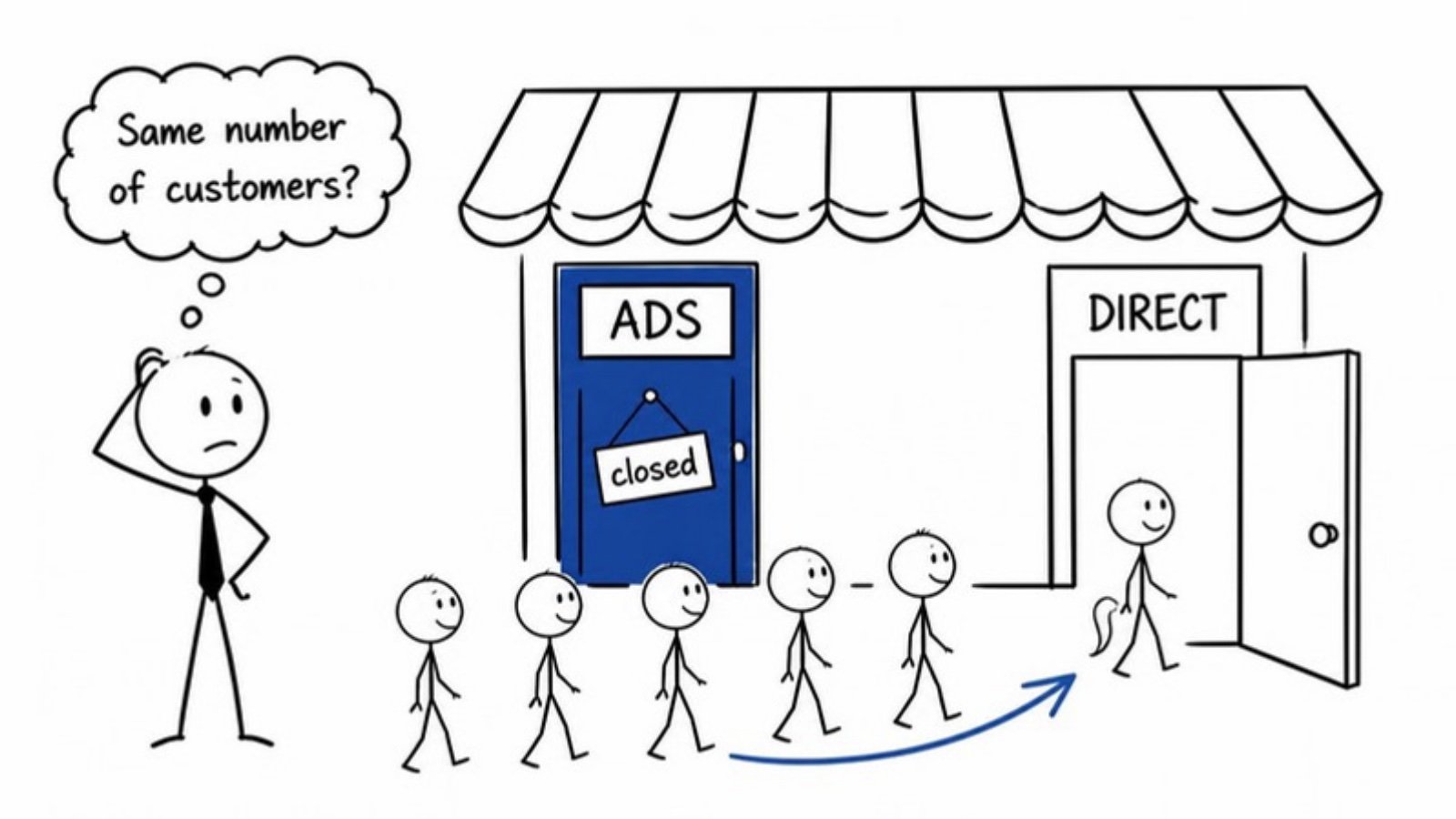
Uber learned the same lesson at a larger scale, with an uglier twist. In March 2017 it suspended its campaign with Fetch Media, a mobile ad agency it said it had paid more than $82.5 million. According to the lawsuit Uber later filed, total app installs did not drop substantially. Installs credited to paid ads fell, and organic installs rose by almost exactly the same number. Uber alleged that Fetch had been taking credit for installs that would have happened anyway. Fetch denied the allegations.
Kevin Frisch, who ran performance marketing at Uber, later described the wider clean-up on the Marketing Today podcast. Uber turned off $100 million of a $150 million annual budget, two thirds of its spend, and in his words 'basically saw no change' in rider app installs. Installs that had been credited to paid channels simply showed up as organic. Much of that story is about fraud: networks faking the last touch so they could claim an install. But fraud is only an extreme version of an ordinary problem. Attribution rules hand credit to whoever touched the customer last, and that rewards standing in front of people who were already going to act.
You might hope that better data fixes this. A 2019 paper in Marketing Science by Brett Gordon and Florian Zettelmeyer of Northwestern, with two Facebook researchers, tested exactly that. They took 15 large advertising experiments on Facebook, 1.6 billion impressions in all, and asked whether standard observational methods, fed rich demographic and behavioural data, could recover the effect the randomised tests found. Mostly they overstated it. In half the studies, the estimated lift in purchases was off by a factor of three.
The reason is the same everywhere. Ads are aimed at people likely to act, so the people who see them were always going to act more than the people who don't. Any comparison of exposed and unexposed customers bakes that difference in and calls it the effect of the ad.
The dashboard asked who clicked before buying; the experiment asked who bought because of the click.
Measure what the ad caused
The grown-up metric is incrementality: sales that happened because of the ad and would not have happened without it. The cleanest way to see it is to withhold the ad from some people and compare. Two Google researchers, Jon Vaver and Jim Koehler, described the method in 2011 as the geo experiment: divide the map into regions, randomly switch ads off in some, compare the results. It is what eBay did. It needs no special software, only discipline about which regions, for how long and which number you will judge.
Judge channels by the incremental cost of a customer you want, not the cost of a click. When a campaign looks brilliant, ask what share of its buyers were existing customers, people searching your name or people already in checkout. Those are the sales most likely to arrive without you paying for them.
Tell the platform what you actually want. Optimise for a qualified lead or a purchase rather than a click, and accept that each click will cost more. The system will find whoever does the thing you name, so name the thing that pays.
Treat a sudden fall in cost per click as a change of audience, not a win, until you know who the new people are. And accept imperfect tests. Small advertisers cannot run eBay-sized experiments, and results will be noisy. A rough holdout still beats a confident attribution report, because it asks the right question: what would have happened if we had spent nothing?
The lesson
A click is cheap either because the market thinks the person behind it is worth little or because that person was coming anyway, so judge ads by the customers they cause, not the clicks they collect.
Try this week: Take your cheapest, best-looking campaign (often brand search), pause it in a few regions for three weeks while it keeps running elsewhere, and compare total sales between the two groups rather than the sales your ad platform claims.
A weekly letter on how people think, buy and work
One idea every Tuesday on psychology, marketing, sales, productivity and technology, with one thing to try that week.
Subscribe free