Productivity
You don't have a time problem. You have a decision problem.
Why better scheduling rarely fixes a busy week
Manish Kumar Singh7 min read
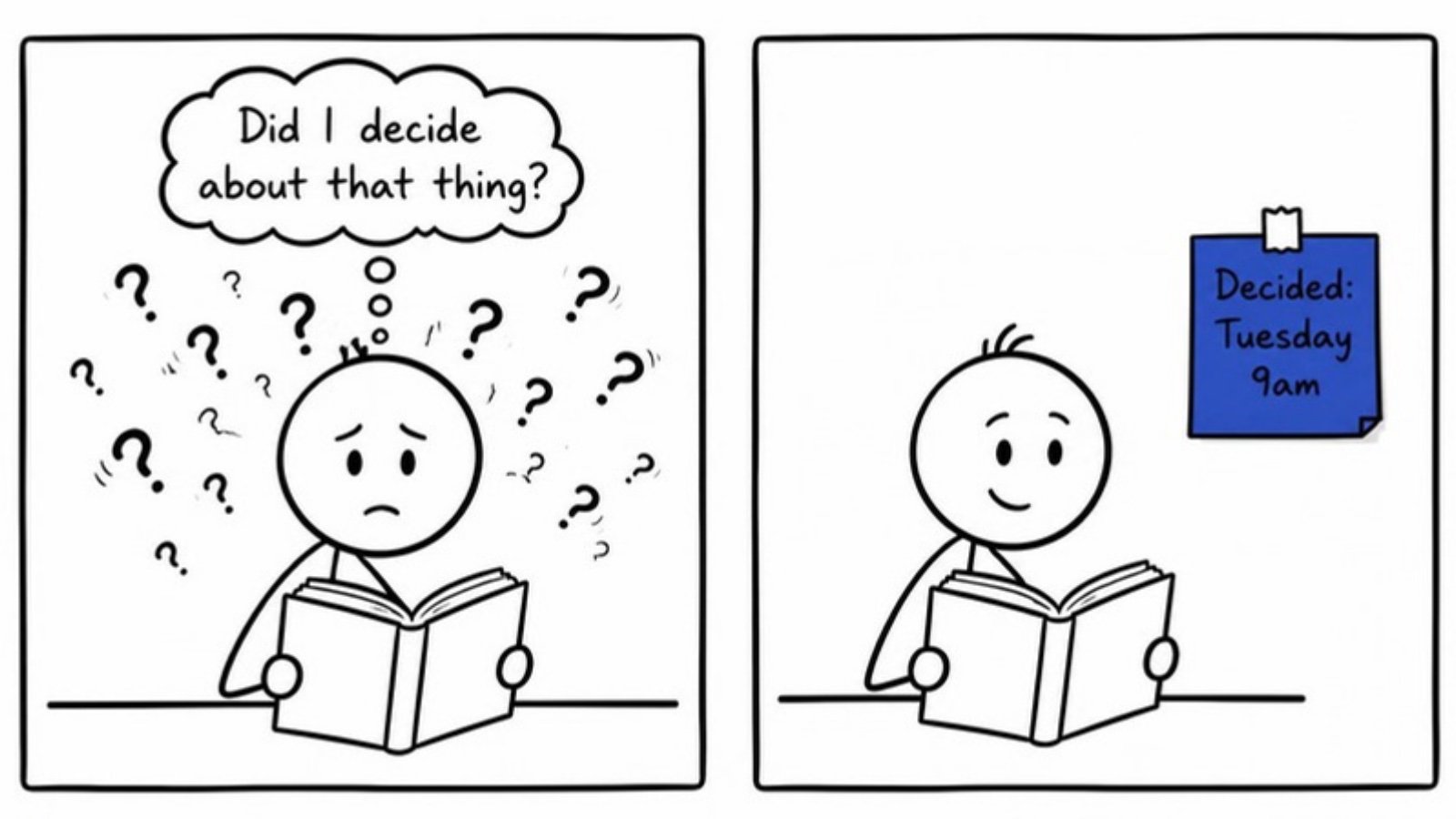
In 2011, two psychologists at Florida State University asked a group of students to name two important tasks they had to finish in the next few days. Everyone then read the opening 3,200 words of an Erle Stanley Gardner detective novel, one word at a time, while a prompt occasionally asked whether their attention had drifted. Students who had just written about their unfinished tasks reported more distraction by them and answered fewer comprehension questions correctly. A third group wrote about the same kind of tasks, then spelled out how, when and where they would do them. Their distraction vanished. They read as well as a control group who had written about tasks they had already completed.
Nobody in that third group had done anything. They had only decided. That result, from E. J. Masicampo and Roy Baumeister, is the best short explanation I know for why a packed week feels so heavy. The weight is rarely the hours. It is the number of things whose next move you have not settled. Calendars, apps and time blocks manage hours. They do not settle anything.
Your mind tracks open decisions, not unfinished work
The idea that unfinished business nags at us is old. The story goes that Kurt Lewin noticed a waiter who remembered unpaid orders in detail and forgot them once the bill was settled. His student Bluma Zeigarnik published experiments in 1927 suggesting that interrupted tasks are remembered better than finished ones, and the 'Zeigarnik effect' has lived in productivity books ever since.
It deserves an asterisk. In 2025, Romain Ghibellini and Beat Meier of the University of Bern published a meta-analysis of the research and found no general memory advantage for unfinished tasks. What did hold up was a sister finding, the Ovsiankina effect: people tend to go back to tasks that were interrupted. Open tasks may not be better remembered, but they do pull at us.
Masicampo and Baumeister's contribution was to show what releases that pull. In another study in the same paper, 97 students were told that their final task would be to list as many sea creatures as they could, and that the best method was to work through the alphabet letter by letter. First, though, they had five minutes to solve anagrams. Students who simply committed to trying their best on the sea-creature task solved fewer anagrams (6.55 on average) than a control group who had not been told the topic (8.39). Students who committed to a specific plan ('When I get to the final task, I will write down the letters of the alphabet and will list sea creatures for each one') solved 9.55. The open goal had been leaking attention, and the plan stopped the leak.
The detail that matters most came next. Seventy per cent of the planners actually used the alphabet method, against 13% of the goal-only group, and the anagram benefit ran through the people who followed through. The mind was not soothed by a plan it didn't mean. It relaxed only when the plan was real.
Two caveats. These were small samples of undergraduates in a single lab, and that lab is also the home of ego depletion, a famous idea that has struggled badly in replication. Treat the result as a strong hint rather than a law. It does, however, fit a much larger body of evidence about planning, which is where this essay ends up.
The hungry judges, and what decision fatigue really shows
If open decisions weigh on us, the obvious next thought is decision fatigue: we make so many choices that by mid-afternoon we have nothing left. Its best-known evidence is a 2011 paper in PNAS by Shai Danziger, Jonathan Levav and Liora Avnaim-Pesso. They analysed more than 1,000 parole rulings by eight experienced Israeli judges and found that favourable rulings started each session at about 65%, fell towards zero as the session wore on, and jumped back to about 65% after a food break.
It is a vivid story, and it has been heavily challenged. Keren Weinshall-Margel and John Shapard pointed out that cases were not heard in random order. Boards tried to finish one prison's cases before a break, and prisoners without lawyers, about a third of all cases, usually went last. Those prisoners won only 15% of the time, against 35% for prisoners with lawyers. The original authors replied that the decline held when they controlled for representation, though they did not say how much smaller it became. In 2016 Andreas Glöckner added a simpler explanation. Favourable rulings took longer (7.37 minutes on average, against 5.21), and judges sensibly avoid starting a long case just before a break. His simulations showed that this alone can produce much of the pattern with no fatigue at all. The psychologist Daniël Lakens went further and argued the effect was simply too large to be plausible. Meanwhile the willpower theory underneath it took a blow when a preregistered replication across 23 labs and 2,141 people found an ego-depletion effect of almost exactly zero (d = 0.04).
So be wary of the claim that you run out of decisions by 4pm. The judges offer a subtler lesson. If Glöckner is right, the famous pattern is what a schedule looks like when it quietly decides for you: which cases get started, which get pushed past lunch. Your calendar does the same thing. Every meeting that recurs because nobody cancelled it, and every task that slides to Friday, is a decision made by default.
Why a better schedule rarely fixes it
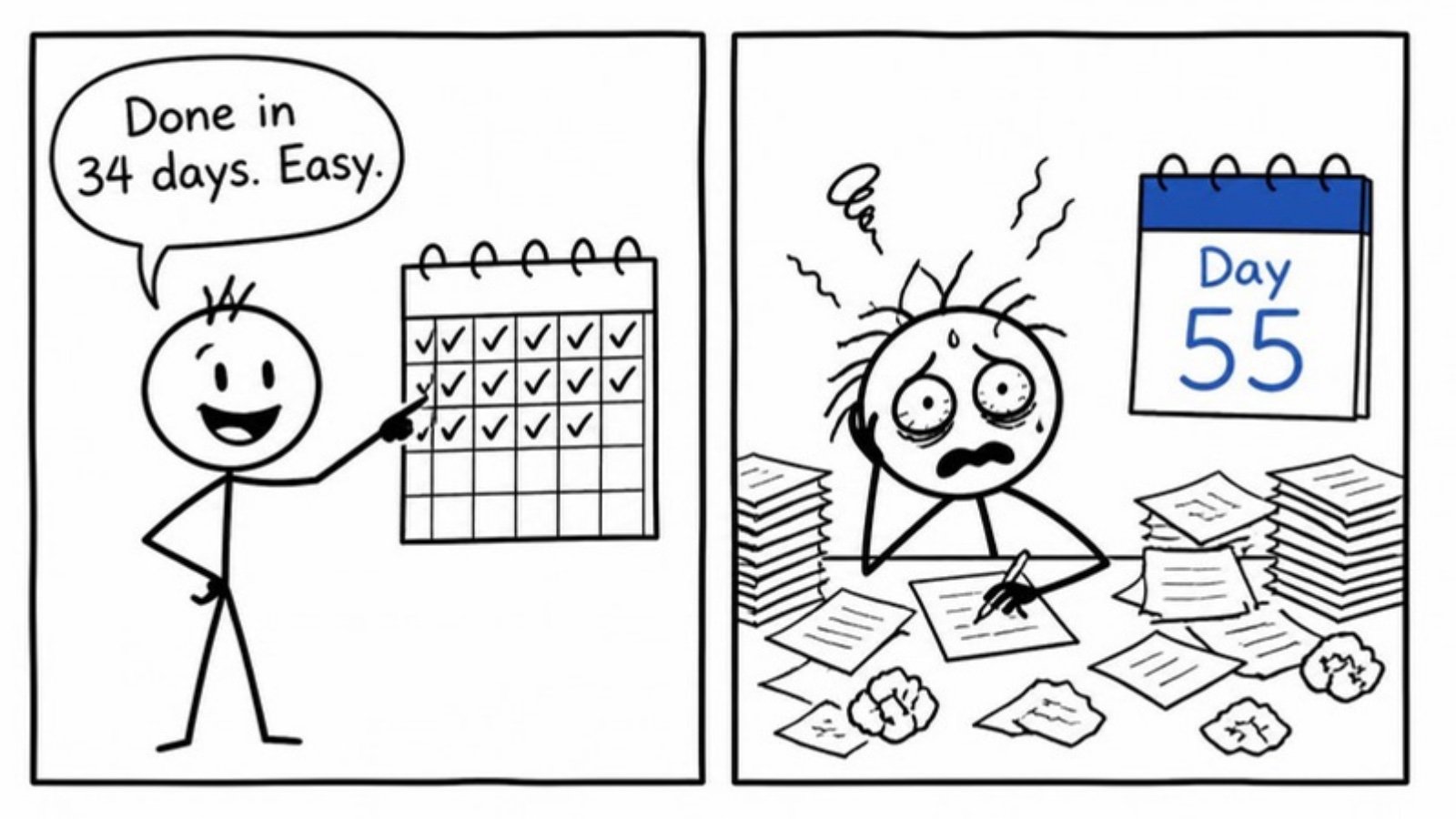
Scheduling looks like the cure because it feels like deciding. It isn't, quite. A schedule is a forecast, and our forecasts about our own work are reliably bad. In 1994 Roger Buehler, Dale Griffin and Michael Ross asked 37 psychology students at the University of Waterloo when they would hand in their honours theses. The average prediction was 33.9 days. The average actual time was 55.5 days. Fewer than a third finished by their own best estimate, and even their forecast 'if everything went as poorly as it possibly could' (48.6 days) came in too early.
In a follow-up study, the researchers asked students to think aloud while they made a prediction. About 74% of their thoughts were about how the coming task would unfold. Only 7% referred to relevant past experience, and 3% to possible obstacles. We plan from the story of the task, not from the record of how such tasks usually go.
Put those findings together and the busy-week trap becomes clear. You take a list full of items whose fate is unsettled, drop them into time blocks built on optimistic forecasts, and watch the plan fall apart by Wednesday. It feels like a shortage of time. What never happened was the harder call: which of these is worth doing at all, and what exactly happens next for the ones that are.
Nobody in that third group had done anything. They had only decided.
What a real decision looks like
The planning research is clear about what works. Peter Gollwitzer calls it an implementation intention: a plan in the form 'when situation X arises, I will do Y'. His 2006 meta-analysis with Paschal Sheeran pooled 94 independent tests and found a medium-to-large effect on reaching goals (d = 0.65). Specificity is the active ingredient. In a field experiment at a large firm, Katherine Milkman and colleagues added a prompt to the flu-shot reminders sent to employees. Writing down only a date nudged vaccination from 33.1% to 34.6%, a difference too small to be reliable. Writing down a date and a time lifted it to 37.3%.
That gives a working definition. A task has been decided when it has a when, a where and a how, and you mean it. Anything short of that is still an open loop, however neatly it sits in your calendar. Here is how to apply that on Monday.
Audit the list, not the calendar. For every item, ask whether its next move is settled. Each one gets one of four fates: done at a specific time in a specific way, handed to a named person, parked with a date to reconsider it, or deleted. 'Later' is not a fate.
Write if-then plans for the few items that matter. Not 'work on the proposal' but 'Tuesday at 9, before I open email, I draft the pricing section'. If the Masicampo results hold, this should also quieten that item for the rest of the day.
Forecast from the record. Before you block out time, check how long the last similar job actually took. That is the step Buehler's students skipped.
Finally, review what your schedule decides by default. Recurring meetings, standing reports and inherited commitments are choices somebody once made. Each one has earned a fresh keep, change or cancel.
The lesson
A heavy week is usually a pile of unmade decisions, and a specific plan you intend to keep does more to lighten it than any extra hour.
Try this week: On Monday, take every item that has sat on your list for more than two weeks and give it a date and time, a named owner, or a delete.
A weekly letter on how people think, buy and work
One idea every Tuesday on psychology, marketing, sales, productivity and technology, with one thing to try that week.
Subscribe free