Sales
The email that gets a reply when a buyer goes quiet
Copy it, then read why each line is there
Manish Kumar Singh7 min read
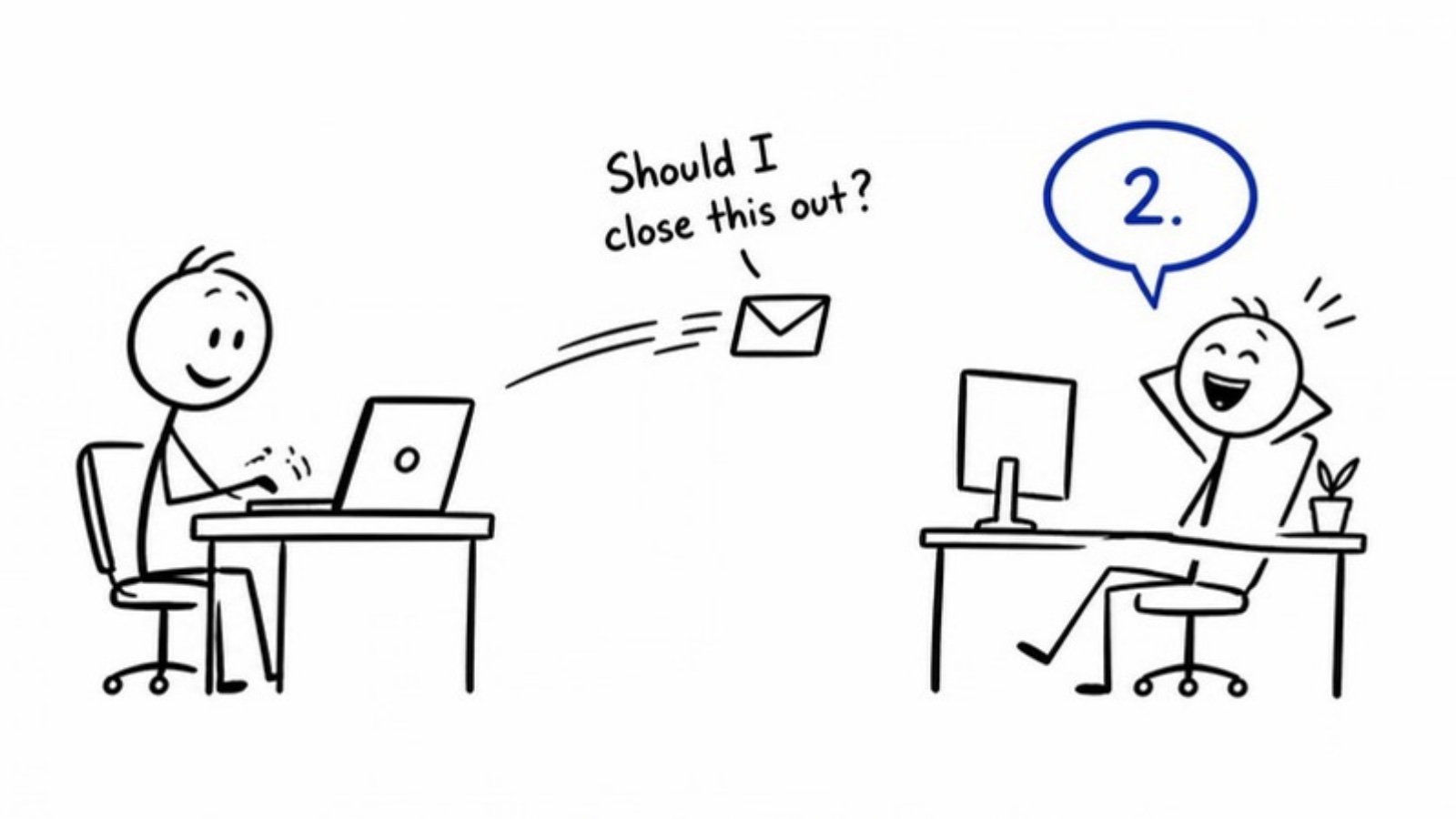
The call went well. They asked for a proposal. You sent it, followed up a week later, then again the week after. Nothing came back. Not a no, not a maybe, just an inbox that has gone quiet.
Most salespeople read that silence as fading interest and try to rebuild it: another case study, another "just checking in". The research on how people respond to requests points somewhere else. The silence is rarely about interest. It is usually about how unpleasant it is to say no.
Here is the email I would send instead. Copy it as it is, then read on to see why each line earns its place.
The email
Subject: Should I close this out?
Hi [Name],
I haven't heard back, which usually means one of three things:
1. The timing isn't right.
2. Priorities have changed.
3. You've gone another way.
Any of those is completely fine. Just reply with a number so I know whether to follow up later or close the file.
[Your name]
It is short and polite, and it says nothing the buyer has not heard before. The work is done by its structure, and each part of that structure lines up with a specific piece of research.
Silence is a no nobody had to say
In 2008 Francis Flynn and Vanessa Lake (who now publishes as Vanessa Bohns) sent Columbia University students out to ask strangers to fill in a questionnaire that took five to ten minutes. Each student needed five people to agree. Beforehand, they predicted they would have to approach about 20 people. They actually needed about 10. In follow-up studies, students who asked strangers to lend them a mobile phone, or to walk them to the campus gym, overestimated how many people they would need to ask in the same way.
The researchers traced the gap to a blind spot. Askers think about what a yes costs the other person in time and effort. They underweight what a no costs: the awkwardness and embarrassment of refusing someone directly. In a 2016 review of studies in which participants had asked more than 14,000 strangers for things, Bohns reported that requesters underestimated compliance by 48 per cent on average, and that the error came from failing to appreciate how awkward it is to say no.
Now move the request into an inbox. In 2017 Mahdi Roghanizad and Bohns ran the same kind of experiment by email. Face to face, people again underestimated how many strangers would agree. By email they overestimated it, and by a wide margin: the in-person requests turned out to be roughly 34 times more effective than identical emailed ones. Email strips out the social pressure that makes refusal hard. When nobody is standing in front of you, the cheapest way to decline is to do nothing.
Your buyer is not a stranger, and a proposal is not a questionnaire, so treat this as a mechanism rather than a measurement. The mechanism fits closely, though. Saying no to someone who spent a week on your proposal is uncomfortable, and silence lets the buyer skip that conversation entirely. Every "just checking in" note makes it worse, because the only honest reply is the awkward one they have been avoiding.
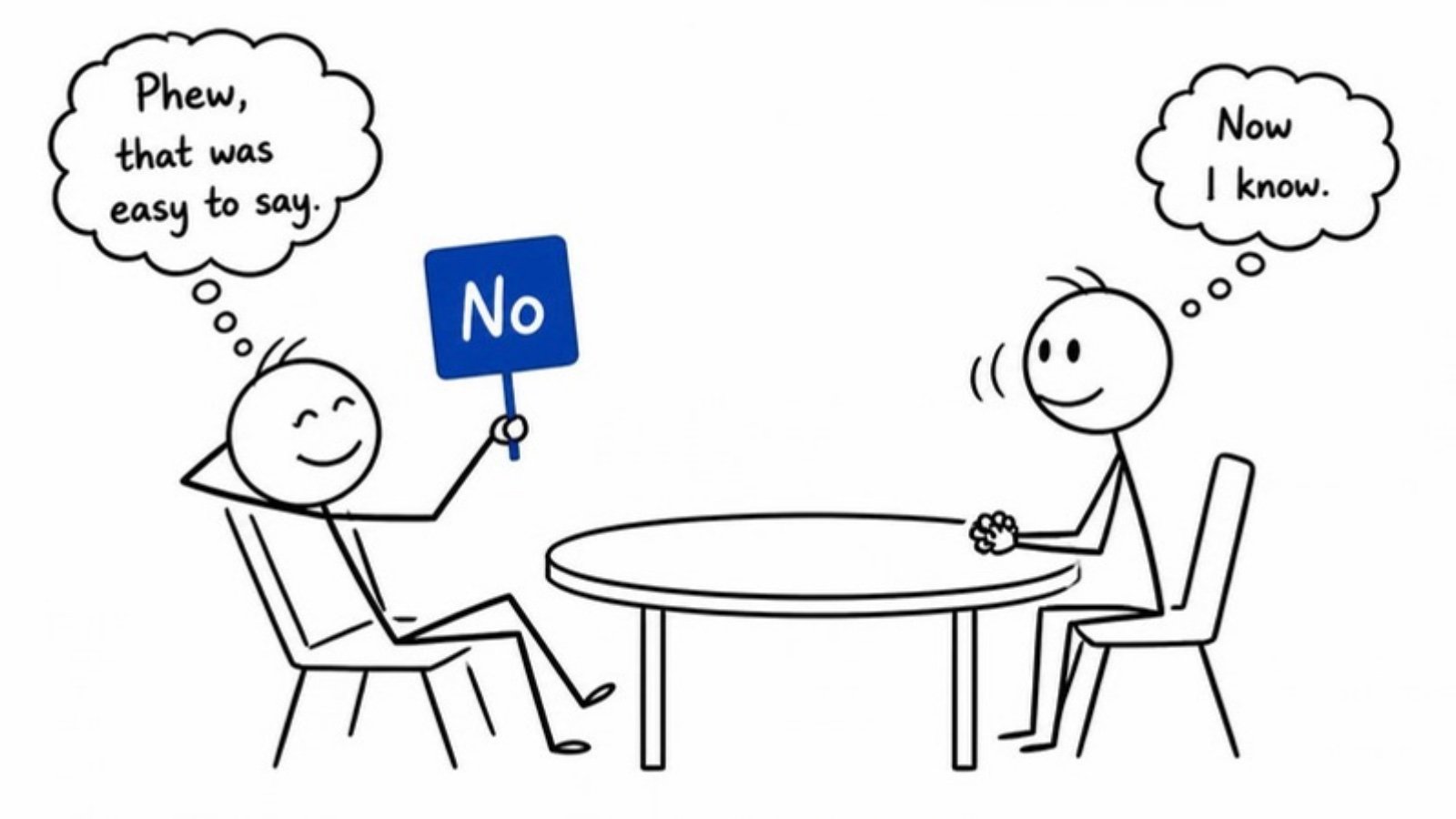
Seen this way, options 2 and 3 in the email are refusals written in advance. The buyer no longer has to compose a polite no. They have to type one digit.
Flynn and Lake's work also explains why the email ends with a plain instruction rather than "let me know your thoughts". In one of their vignette studies, people imagining themselves on the receiving end judged an explicit request ("Will you help me with this?") as more awkward to turn down than a need that was only implied. A vague sign-off is an implied request, and implied requests are easy to leave unanswered. "Reply with a number" is explicit. So the email does two things at once: it makes silence a little harder to justify, and it makes the no itself almost effortless.
Permission to say no
Asking for a no on purpose is an idea most people meet through Chris Voss, the former FBI hostage negotiator. In Never Split the Difference (2016, written with Tahl Raz), a chapter titled "Beware 'Yes', Master 'No'" argues that saying no makes people feel safe and in control, while a question built to extract a yes puts them on guard. For a counterpart who has stopped responding, Voss recommends a short no-oriented question: "Have you given up on this project?"
His firm, the Black Swan Group, still teaches a version of it: a subject line reading "Have you given up on [blank]?" with nothing in the body. Their explanation is that nobody wants their name attached to giving up, especially on something they have not quite given up on.
The email above is a gentler cousin of that line. It does not hint that the buyer is a quitter. It offers three exits and says all of them are acceptable. That sentence, "Any of those is completely fine", has its own research history. In 2000 the French psychologists Nicolas Guéguen and Alexandre Pascual had a stranger ask shoppers in a mall for coins for the bus. Adding "But you are free to accept or to refuse" made people more likely to give, and those who gave handed over about twice as much.
A 2013 meta-analysis by Christopher Carpenter pooled 42 studies with more than 22,000 participants and found that reminding people they were free to refuse roughly doubled the odds of a yes. Two caveats matter for sales. The effect was weaker when people decided later rather than on the spot, which is exactly the email situation. And a 2023 re-examination led by Adrien Fillon found signs of publication bias; among the seven studies judged at lowest risk of bias, the effect was not significant. So the freedom line is worth keeping, but the heavy lifting is done by the pre-written answers, not by any magic phrase.
What "close the file" really does
Voss explains the pull of his question with loss aversion, the idea from Daniel Kahneman and Amos Tversky that losses weigh more than equivalent gains. In a 1991 paper they concluded that a loss aversion coefficient of about two fits a range of experiments: losing something hurts roughly twice as much as gaining it pleases.
That explanation is popular, and it is contested. In 2018 David Gal and Derek Rucker argued in the Journal of Consumer Psychology that current evidence does not show losses are, on balance, more powerful than gains. Many effects credited to loss aversion, they said, are better explained by a preference for inaction: people stick with the status quo because doing nothing is easy. Other researchers replied in its defence, and the argument is not settled.
Here is the useful part. Under either explanation, "close the file" works for the same reason. Before this email, doing nothing cost the buyer nothing. The option stayed open, the vendor kept writing, and no decision was needed. After it, doing nothing has a consequence, because the file closes. You have changed what inaction means. A buyer who is drifting rather than finished now has a reason to type "2" or "1, try me in March".
This only works if it is true. If you send the email and keep chasing anyway, the next one carries no weight. Closing the file has to mean closing it.
When nobody is standing in front of you, the cheapest way to decline is to do nothing.
What to do with each answer
A 1 is a timing problem. Ask when to check back, put the date in your calendar, and stay quiet until then.
A 2 means something changed inside their business. Ask what. It is often a budget cut, a new boss or a reshuffled plan, and the answer tells you when it makes sense to return.
A 3 is more valuable than it feels. Thank them and ask one question: what made the other option the better fit? Pipelines are full of deals that were lost weeks ago and are still being counted. A clear no cleans up your forecast, and the reason behind it often says more about your pricing or pitch than a win does.
Timing matters. This is not an opening move. Send it only after the buyer has asked for something and then gone quiet through a couple of ordinary follow-ups. Sent earlier, it reads as pressure.
One honest note on results. Practitioners who use versions of this email report high reply rates, and Black Swan says a response within 48 hours is likely. I have not found a controlled study of reply rates for this kind of email, so treat those claims as anecdote. What the research does support is the mechanism. People avoid saying no, email makes avoiding it easy, and a follow-up that makes no cheap and silence costly removes both problems at once.
The lesson
Buyers rarely go quiet because they are rude; they go quiet because saying no is uncomfortable, so write the no for them and make silence mean something.
Try this week: Pull every proposal that has had no reply for more than two weeks, send each one this email, and record the number that comes back in your CRM.
A weekly letter on how people think, buy and work
One idea every Tuesday on psychology, marketing, sales, productivity and technology, with one thing to try that week.
Subscribe free