Psychology
Nobody is watching you as closely as you think
The spotlight effect, and what it quietly costs you
Manish Kumar Singh7 min read
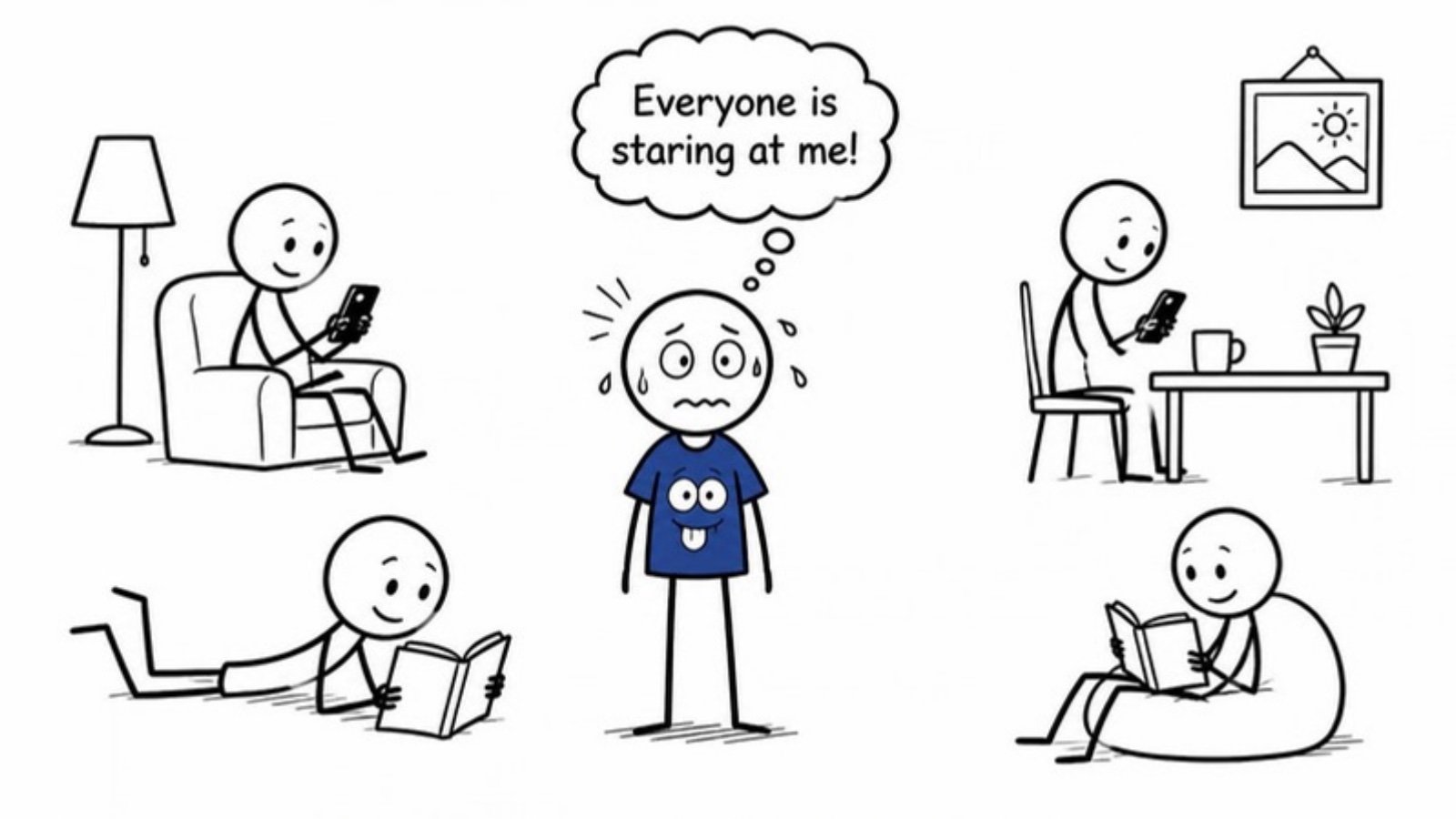
In a study published in 2000, Cornell students were handed a T-shirt with Barry Manilow's face printed across the chest, a singer few undergraduates would choose to be seen with. Each wearer was sent into a room where a handful of other students sat filling in questionnaires, waved back out a moment later, and then asked a simple question: how many of those people could say who was on your shirt?
The wearers' average guess was 46 per cent. The real figure was 23 per cent, exactly half. Then the psychologists behind the study, Thomas Gilovich, Victoria Husted Medvec and Kenneth Savitsky, ran it again with shirts people were glad to wear, showing Bob Marley, Jerry Seinfeld or Martin Luther King Jr. The wearers predicted that 48 per cent of the room would notice. Just 8 per cent did.
That second result is the one worth keeping. The spotlight effect is usually told as a comfort story: relax, nobody saw you trip. But the bias that inflates your embarrassments inflates your triumphs too. The room is not watching your worst moment, and it is not watching your best one either. And a newer line of research adds a twist that is kinder still: when people do pay attention to you, they tend to judge you more warmly than you assume.
Why the spotlight feels so bright
The researchers' explanation is anchoring and adjustment. You start from your own experience, and from the inside the shirt feels enormous. You know, in the abstract, that other people are less focused on you, so you adjust your estimate downward. But the adjustment stops too early, and you land well above reality.
Two follow-up studies support this. In one, students wearing a Vanilla Ice T-shirt were asked whether they had considered any other number before settling on their estimate. Of the 30 who named an alternative that was clearly above or below their answer, 23 said it had been higher. People started high and trimmed. In another, some participants wore the Manilow shirt for 15 minutes before entering the room, long enough to get used to it. They estimated that 37 per cent of observers would notice, against 51 per cent for those who went in straight away. Same shirt, same kind of room. The only thing that changed was how loud the shirt felt to the person wearing it.
The effect is not limited to clothes. In a third study, 193 students discussed a touchy policy topic in small groups and then estimated how the group would rank them. They overestimated how much their speech errors and possibly offensive remarks had stood out, and also how much their best contributions had.
Two honest caveats. The T-shirt studies were small, with 15 wearers each. And people were not clueless: in the first study, wearers' guesses rose and fell with the real numbers. The direction of their judgement was right. The size was wrong. The authors also note the mirror image: things you have stopped noticing about yourself, such as a habit you no longer register, may be more visible to others than you think. The spotlight tracks your attention, not the audience's.
Your nerves are not on display
The same team found a sibling bias they called the illusion of transparency: the belief that your inner states leak out more than they do. In a 1998 study, students played a lying game in groups of five, each telling one lie across several rounds while the others guessed who was lying. Liars expected 48.8 per cent of the other players to catch them. Only 25.6 per cent did, which is about what you would expect from pure guessing. In another study, people who tasted a foul drink while trying to keep a straight face thought their disgust was obvious. Observers did no better than chance.
The researchers also describe negotiation studies in which people believed they had given away more about their preferences than they really had. Anyone who has quoted a fee and heard their own voice wobble will recognise the feeling. The client was most likely just hearing a number.
The practical payoff came in 2003. Savitsky and Gilovich had students give short speeches with little preparation. One group was simply told about the illusion of transparency, that nervousness is far less visible to an audience than it feels. Compared with a control group, those speakers rated their own speeches more favourably and, more tellingly, observers rated the speeches better too. Knowing that the audience cannot see your pulse made the pulse matter less.
The kinder surprise: they like you more than you think
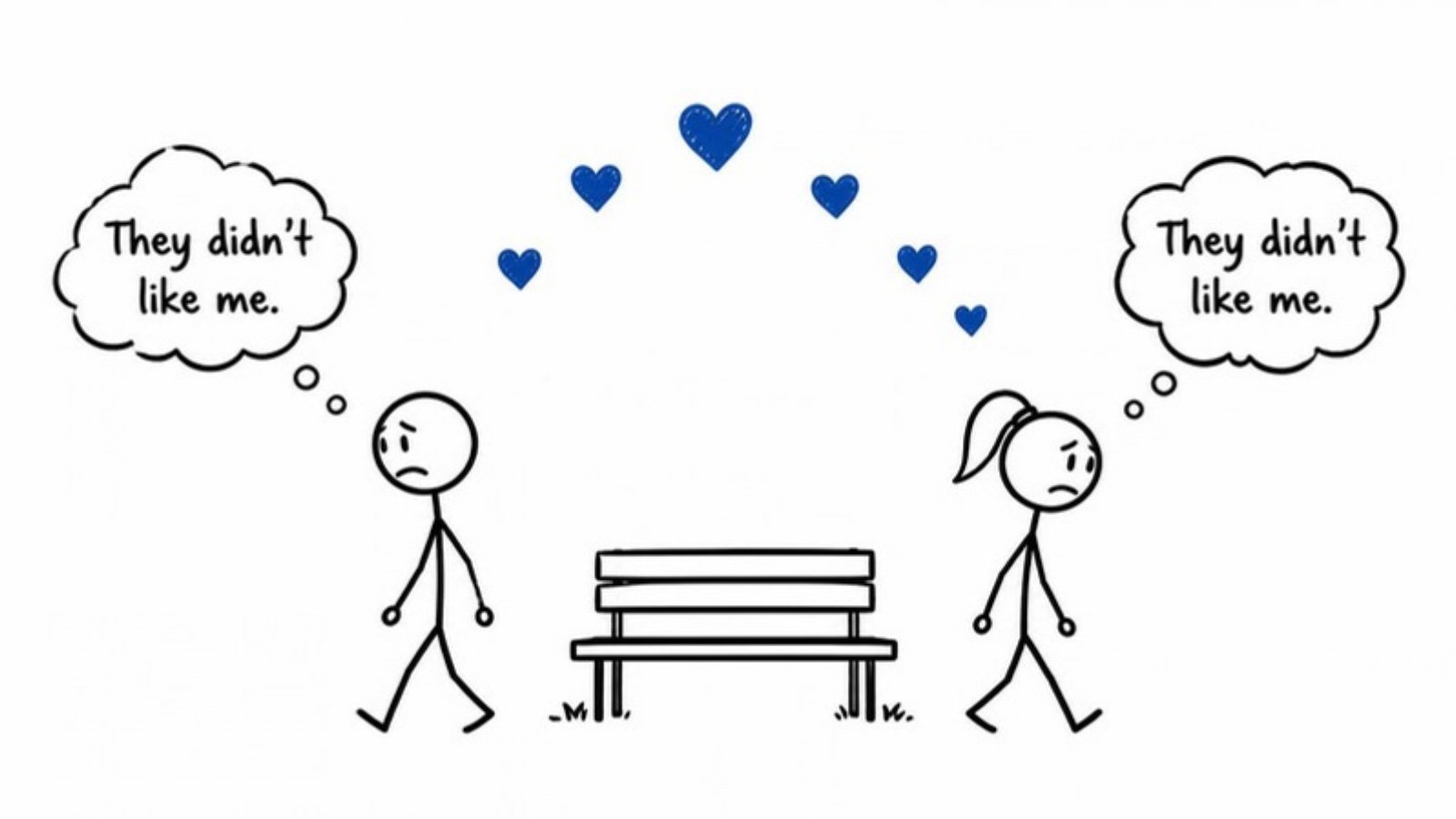
In 2018, Erica Boothby, Gus Cooney, Gillian Sandstrom and Margaret Clark paired strangers for roughly five-minute conversations, then asked each person two things: how much they liked their partner, and how much they thought their partner liked them. On a seven-point scale, people reported liking their partner at 5.82, but guessed their partner liked them at only 5.17. On average, both cannot be true. The error is on the guessing side, and the researchers named it the liking gap.
This runs against one of psychology's best-known findings. Decades of research show people rate themselves above average on everything from their marriages to their driving. Conversation seems to be an exception. The Boothby team points to emerging evidence that when people think about their social interactions, their outlook turns decidedly less rosy.
The most striking detail is where the error comes from. Research assistants who watched videos of the conversations could predict how much each person liked the other. The signals were there. The people in the conversation missed them, because their attention was on their own performance. After talking, their most prominent thoughts about how they had come across were more negative than their thoughts about the other person, and that negativity helped explain the gap. The shyer the person, the wider it was.
Nor is it a first-meeting quirk. In a year-long study of 102 Yale first-year students, people underestimated how much their suite mates liked them in September, October, December and February. Only by May had the gap closed. A 2021 study by Adam Mastroianni and colleagues found the same pattern in small groups and in engineering teams working on a shared project. People who felt less liked were less comfortable asking teammates for help or speaking honestly with them, even after accounting for how much they liked their teammates. That link is correlational, but the direction is worrying for any team.
Related work points the same way. Anna Bruk, Sabine Scholl and Herbert Bless ran seven studies on what they called the beautiful mess effect. When people pictured themselves confessing feelings, revealing a physical imperfection or asking for help, they judged it more harshly than when they pictured someone else doing exactly the same thing. Up close, you see the concrete risk. From a distance, observers see the more abstract qualities, such as honesty and courage. Much of this evidence comes from imagined scenarios, and it has limits. In three lab experiments, Kerry Roberts Gibson, Dana Harari and Jennifer Carson Marr found that when a higher-status colleague disclosed a weakness during a shared task, that person lost status and influence. Peers who said the same thing did not. Kindness from observers is real, but people expect strength from those in charge.
The room is not watching your worst moment, and it is not watching your best one either.
What to do with this at work
Ask the question in the meeting. The group-discussion study suggests that your clumsy moments register less than you fear, and the liking research suggests people read you more generously than your inner critic does.
Publish, then say it again. The flattering-shirt result cuts both ways: if 8 per cent of a room noticed something people were proud to wear, your best post, launch or case study is being missed by most of the people you imagine reading it. Repetition feels excessive to you because you have heard yourself every time. Most of your audience has not.
When you pitch or state a price, say the number and stop talking. The wobble you feel is mostly invisible, as the liars and tasters showed. Before a big presentation, remind yourself or your team of that fact. In the 2003 study, the information alone improved performance.
Follow up after first meetings. The liking gap means you will usually underrate how much a prospect, new client or candidate enjoyed talking to you, and that underrating is exactly what makes people hesitate over the follow-up email. If you lead a team, admit mistakes about the work, but be aware that the beautiful mess has limits for the person at the top.
More broadly, treat your own sense of how a meeting went as a biased instrument. In the suite-mates study the gap took months to close, which is a long time to wait in business. Look at behaviour instead: did they reply quickly, book the next call, bring a colleague along?
The lesson
Other people notice you less and like you more than your inner critic claims, so the cautious choice is often the expensive one.
Try this week: After your next call with someone new, send the follow-up you would normally hesitate over within the hour, and note how warm the reply is compared with what you expected.
A weekly letter on how people think, buy and work
One idea every Tuesday on psychology, marketing, sales, productivity and technology, with one thing to try that week.
Subscribe free